
MI–0002 Recorded August 28, 2026
Agreements become unstable when exit is rewarded
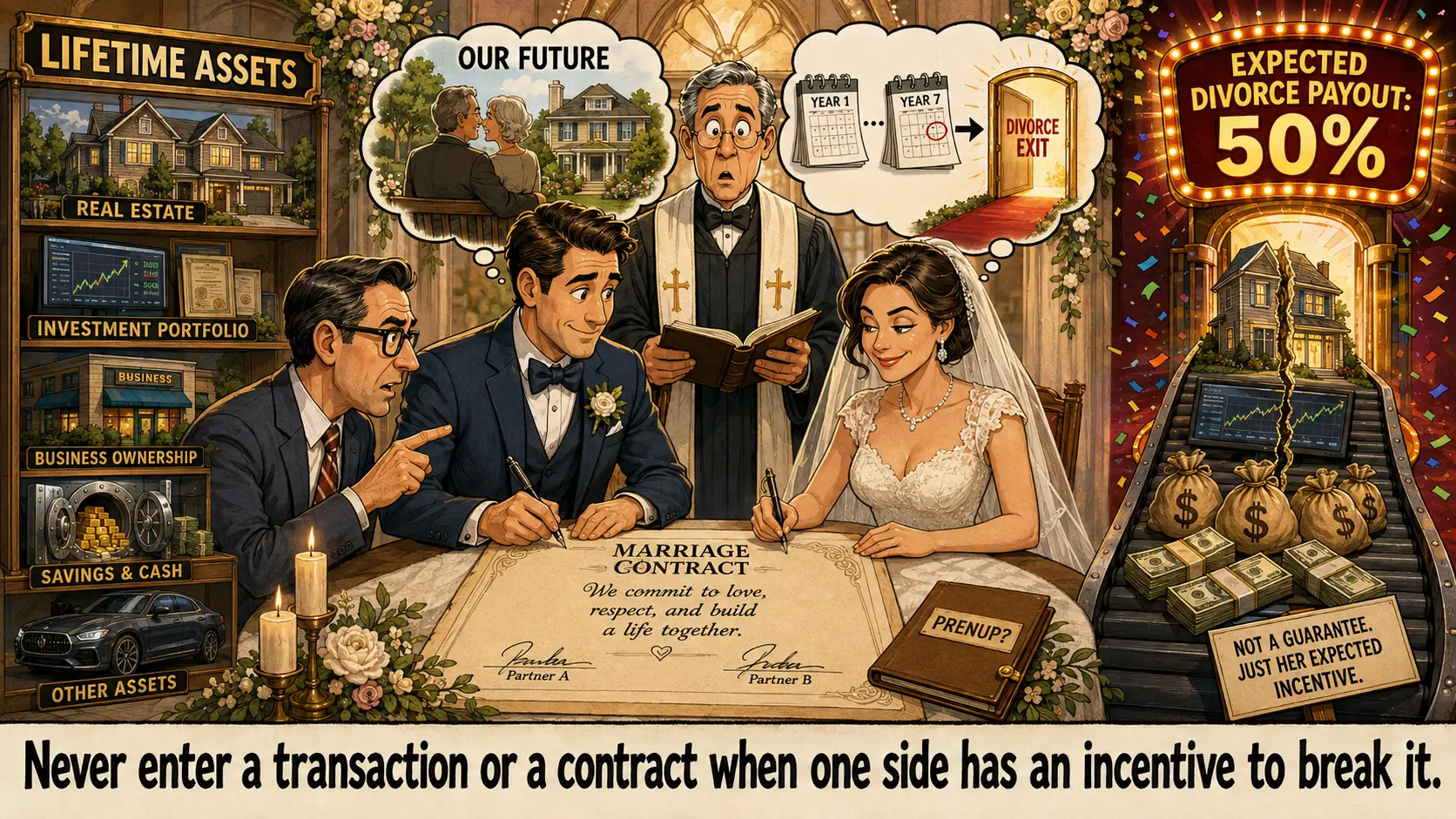
Never enter a transaction or a contract when one side has an incentive to break it.

Refined insight
An agreement is only as durable as the incentives to preserve it.
The underlying insight
Agreements are structurally vulnerable when a party expects to benefit more from breaking the agreement than from honoring it. This lens can be applied to contracts, partnerships, employment arrangements, business deals, and personal relationships.
This is not about gender
The opening illustration happens to show a man entering with more assets and a woman potentially benefiting from the exit. Reverse their roles and the principle is unchanged. The article makes no claim that either women or men are less committed, more calculating or more likely to leave.
The concern is structural rather than personal: whenever either party can reasonably expect a disproportionate benefit from ending an agreement, that incentive deserves examination. Who holds the assets and who receives the benefit may change; the contract-design problem does not.

The incentive may be dormant at the beginning
A marriage does not have to begin with calculation or bad faith for an unequal exit incentive to matter later. Both people may enter fully committed, expecting to build a life together and never seriously considering separation. While the relationship is healthy, the possible financial consequences of leaving may be psychologically irrelevant.
Most long partnerships nevertheless encounter periods of disappointment, conflict, exhaustion, resentment or uncertainty. At that point, the question changes. The couple is no longer deciding whether to begin the partnership; one or both people are deciding whether to repair it, tolerate the present difficulty or leave. An exit benefit that meant little on the wedding day can then become part of the calculation precisely when judgment is under the greatest pressure.
A thumb on the scale, not a puppet string
The incentive does not have to create the original problem or determine the final decision. It may simply make leaving comparatively more attractive, less frightening or easier to justify. That can lower the threshold at which a temporary crisis is interpreted as permanent, reduce the willingness to endure an uncomfortable repair process, or reinforce reasons for separation that already exist.
This is why the important claim is not that an unequal incentive will probably cause a marriage to fail. The stronger and more defensible point is that it can disproportionately influence a close decision. When the emotional reasons for staying and leaving are finely balanced, even a secondary financial incentive may become consequential.

The imbalance can develop over time
The practical incentives inside an agreement are not frozen when it is signed. Assets accumulate, careers diverge, one partner may contribute more unpaid labor, earning power changes and the perceived cost of starting again rises or falls. An arrangement that felt balanced at the beginning can therefore produce a very different set of incentives years later, even when neither person originally anticipated the change.
That suggests a broader contract-design lesson: evaluate not only whether an agreement looks fair today, but how its incentives may behave under future stress. The moment when cooperation becomes difficult is the moment when the structure of the agreement matters most.
Protection and incentive can both be real
Financial protections for a lower-earning or economically vulnerable spouse may serve legitimate purposes. They may recognize unpaid contributions, reduce hardship or prevent one partner from being trapped by financial dependence. Acknowledging the possible incentive effect does not mean those protections are wrong or that every favorable settlement is a windfall.
The design problem is to protect people fairly while recognizing that every expected outcome can influence behavior. The relevant question is not simply, “Who receives what?” It is, “How might each person’s expected position affect the decision to repair, endure or exit when the relationship becomes difficult?”
The principle is broader than marriage
In business, the dangerous incentive is not always to breach the agreement directly. A party may instead benefit from declaring, magnifying or refusing to cure the other party’s alleged default. The practical question is therefore broader than, “Who has an incentive to break the contract?” It is also, “Who benefits if the contract fails, and who controls the facts or decisions that determine whether it has failed?”
Lease-to-own or installment purchase. Imagine that a customer makes regular payments toward eventual ownership while the seller keeps legal title until every condition has been satisfied. If a late, disputed or imperfectly recorded payment permits the seller to terminate the arrangement, retain the accumulated payments and keep or repossess the asset, the seller may receive more from default than from successful completion. That creates an incentive to interpret ambiguity as breach rather than help cure it. It does not prove that a particular seller will act improperly, and the legal result depends on the agreement and applicable law. But the structure is real: the Consumer Financial Protection Bureau has documented contracts for deed in which a seller retains title and forfeiture can allow the seller to retake a home while keeping the buyer’s accumulated payments and equity.

A business-sale earn-out. A founder may sell a company for an upfront price plus a later payment if the business reaches specified revenue, profit or product milestones. After closing, however, the buyer may control staffing, investment, product priorities, accounting and the calculation of the milestone itself. The buyer can therefore face a conflict: a decision may serve its broader organization while reducing or eliminating the payment owed to the seller. That does not make every missed earn-out manipulative. It does explain why real acquisition agreements define the measurements, require supporting records, give the seller review rights and send unresolved calculations to an independent accountant.

Both examples reveal the same pattern. One party may control the evidence, interpretation or operating decisions that trigger failure while also receiving a financial benefit from that failure. Good intentions and legal duties may restrain the incentive, but they do not erase it.
Design against the temptation
A resilient contract separates the power to declare failure from the reward that follows it. Useful safeguards can include objective payment records and performance measures; prompt notice of a claimed breach; a meaningful opportunity to cure it; remedies proportionate to the actual harm; credit for value or equity already accumulated; information and audit rights; limits on unilateral control of performance; and a neutral decision-maker for disputed facts.
No safeguard makes conflict impossible. The aim is to prevent one party from being judge, beneficiary and gatekeeper at the same time—and to make successful completion at least as attractive as engineered failure.
Origin and context
Tim’s observation about contracts, transactions, and marriage. He applied it to situations in which one spouse may perceive a financial advantage from ending a marriage and receiving a share of marital assets.
Independent formulation of an established concept
Where this insight comes from
The wording is recorded as Tim’s formulation, with no close earlier version located. Its underlying principle has a well-established lineage in incentive compatibility, moral hazard, contract design and mechanism design: agreements work better when the parties benefit from preserving them.
Mechanism design explainedLeonid Hurwicz and the fieldCFPB: contracts for deedExample acquisition earn-out terms