
MI–0006 Recorded September 6, 2026
Comparison is the thief of joy
Comparison is the thief of joy.

Refined insight
Nothing has to be taken away from us for us to feel poorer. Sometimes we need only be shown somebody who appears to have more.
The spark for this insight
Where we first encountered the idea
This short piece of crowd work by comedian Jimmy Carr is where we were first introduced to the concept behind this Magical Insight. A question about Elon Musk's wealth becomes a sharp observation about comparison—and about how social media has enormously expanded the group of people against whom we measure ourselves.
Video: Heckler asks Jimmy about Elon Musk becoming a trillionaire, published by Jimmy Carr on YouTube. Watch directly on YouTube.
This video was the immediate inspiration for recording the insight. The familiar saying and the underlying research have a longer history, described in the provenance section below.
Nothing changed except the comparison
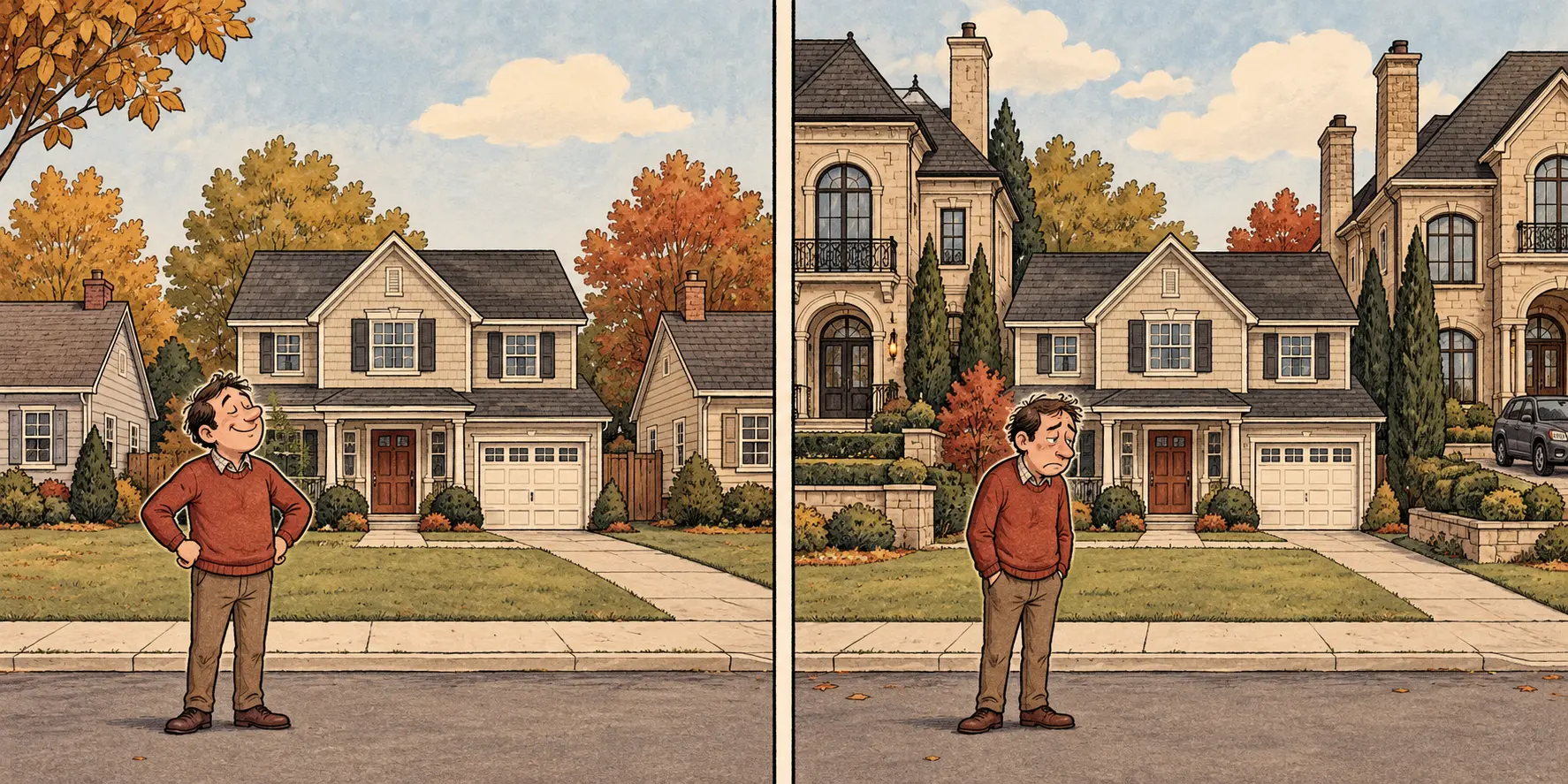
Imagine two people living in essentially the same $300,000 house and enjoying the same standard of living.
One lives in a neighborhood where the average home is worth around $250,000. Looking around, that person may feel successful and fortunate. The other lives among homes averaging $400,000. Looking around, that person may feel as though they are falling behind.
The houses provide the same shelter, comfort and usefulness. Their material circumstances are essentially identical. Yet one house feels like evidence of success while the other feels inadequate.
The difference is not what they have. It is what they have compared with what they see around them.
We rarely judge our lives in isolation
People naturally use those around them as reference points. We compare houses, income, careers, relationships, appearance, possessions and achievements.
That means satisfaction is determined by more than the actual quality of our lives. It is also influenced by where we believe we stand in relation to other people.
Nothing has to be taken away from us for us to feel poorer. Sometimes we need only be shown somebody who appears to have more.
We live better—but do not always feel richer
Many ordinary households now enjoy heating and cooling, indoor plumbing, refrigeration, washing machines, cars, televisions, computers and smartphones. A century ago, many of those comforts were unavailable or restricted to the wealthy.
The physical improvement is independently verifiable. A century-long change in national happiness is not, because consistent U.S. happiness surveys only begin in the 1970s.
Tim's interpretation: Vast material progress has not produced an obviously comparable increase in felt happiness. Our standard of living can be measured against history, but our satisfaction is usually measured against the people around us now.
Media made everyone our neighbor
Media did not create comparison. It magnifies it.
Traditional and social media have expanded our neighborhood to include billionaires, celebrities, influencers and carefully selected glimpses of millions of other lives. We are no longer comparing our ordinary Tuesday with our neighbor's ordinary Tuesday. We are comparing it with the most impressive moments from the most exceptional lives in the world.
Our own lives may not have become any worse. The reference point has simply moved far beyond them.
The McMansion effect
Economist Clément Bellet studied what happened when exceptionally large houses were built in American suburbs. The nearby homeowners' houses did not shrink or become less functional, but their satisfaction with their own homes declined. Some became more likely to enlarge their homes, move to something bigger or take on additional debt.
Related research by economist Erzo Luttmer found that people reported lower happiness when their neighbors earned more, even after accounting for their own income.
What we have matters. But how it compares with what others have matters too.
Comparison is not always the enemy
Comparison can help us learn, recognize possibilities and improve. Seeing somebody accomplish something worthwhile can inspire us to attempt it ourselves.
The problem begins when comparison stops being a source of information and becomes a measure of our worth.
Healthy comparison asks: What can I learn from this person?
Destructive comparison asks: What does this person's success say about me?
Sister insight
Two sides of the same idea
This insight diagnoses the moving reference point that can steal satisfaction. MI–0007: Happiness is a choice describes the response: accepting and appreciating the present without abandoning worthwhile progress.
Comparison explains why having more may fail to make us happy. Choice explains how we can be happy without waiting for more.
The practical magic
When something that once felt satisfactory suddenly feels inadequate, pause and ask: Has my life actually become worse, or has my reference point changed?
Sometimes the missing ingredient is not a larger house, a higher income or a more impressive life. It is freedom from a comparison that has quietly stolen the pleasure from what we already have.
Established saying; ultimate source uncertain
Where this insight comes from
The line is frequently attributed to Theodore Roosevelt, but researchers have found no reliable primary source showing that he said or wrote it. The exact modern wording was in print by 2004, where it was introduced as something “somebody once said,” leaving its ultimate author unresolved.
The idea itself has strong roots in research on social comparison, relative income and positional goods. Bellet's “McMansion effect” and Luttmer's study of neighboring incomes provide especially direct support for the house-and-neighborhood example.
Explore the quotation's historyRead the McMansion researchRead “Neighbors as Negatives”Explore historical housingExplore the happiness record