
MI–0030 Recorded October 23, 2026 · By Tim Barrie
Your Best People Are Your Biggest MISSED Opportunity
They’re already outperforming everyone else. That doesn’t mean they’re anywhere near their potential.
The power move: How to Stop Fixing Weakness. Start Unleashing Talent.


Being the best does not mean being near your limit
The surprising truth: Your best performers can improve far more than your average performers.
A manager looks at a sales team and sees three groups. The strongest people are already doing well. The middle group seems to have plenty of room to improve. The weakest people plainly need help. It feels sensible to devote most development time to the middle and leave the stars to get on with it.
That reasoning quietly assumes that the best people are already producing close to everything they can. Their position in the team provides no such information. They may be achieving exceptional results despite a poorly organized working day, unnecessary administration or a method that could become much more efficient.
Tim Barrie found that some of his largest gains came from enabling people who were already his strongest performers. The question became: what is restricting this person’s output, and what would happen if we changed it?
Being your best performer does not mean someone is fully stretched. Their current responsibilities may reveal only part of what they can do.
The books that helped change the question
Developing an existing strength can offer more opportunity than repeatedly repairing a weakness.
Tim identifies First, Break All the Rules, by Marcus Buckingham and Curt Coffman (1999), and Now, Discover Your Strengths, by Marcus Buckingham and Donald O. Clifton (2001), as influences on this way of thinking. The latter states the principle directly:
“Each person's greatest room for growth is in the areas of his or her greatest strength.”
Source 1: publisher’s excerpt. The argument is to study and develop what people do particularly well, rather than assume that fixing weaknesses is the main route to excellence.
First, Break All the Rules describes managers who select for talent, specify desired outcomes, develop individual strengths and seek a suitable role for each person. It challenges the assumption that enough training can make every person exceptional at any chosen job. Source 2: publisher’s description.
These ideas inform the account below. Tim’s particular combination of ranking, three-month deadlines, recruitment, daily dashboards and prizes is his own management approach. The books are not cited as proof that this entire package, or compulsory replacement of a bottom percentage, is universally effective.
Jean’s story: being above average was only the beginning
A person already doing exceptionally well may still have substantial room to grow.
The data-entry example Tim remembered appears in First, Break All the Rules. Jean P. initially produced 560,000 keypunches a month against a cited national average of 380,000. Her manager recognized her achievement and helped her set individual goals and track progress.
Three months later, she reached one million. A subsequent day’s output of 112,000 led Jean herself to propose a two-million monthly goal. They made a plan; the book says she passed that goal six months later. Her eventual personal best was 3,526,000, while the average among colleagues around her exceeded one million.
The manager observed Jean, explored her competitive enjoyment of counting, and developed a hiring profile and compensation plan around excellence. The account also reports fewer mistakes as her output increased. Source 5: Jean P.’s story in the book.
This is a workplace case, not a controlled experiment. The passage does not detail her workflow or hours, and does not say she reached three million within six months.
Why this belongs beside Tim’s experience
Tim’s interpretation is that a comparison with ordinary performance can make an exceptional person look fully developed long before their potential has been explored. Jean’s story gives a concrete example of the possibility that inspired his approach.
His own examples add practical ways to pursue that possibility: assistants remove administration, workshops reduce repeated presentations, and reusable training enables a team to act independently. Jean’s account supports the question of untapped potential; Tim’s experiences explain the methods he used to uncover it.

Two examples: build around what people do well
Exceptional performance can come from a distinctive way of doing the work.
Warren Buffett: make the role fit the strengths
In an excerpt from Now, Discover Your Strengths, Gallup describes Buffett building an investing approach around patience, practical understanding and trust. A long investment horizon suited his patience; choosing businesses he understood suited his practical judgment; carefully selecting managers and giving them room suited his approach to people. The authors’ point is that he developed a way of working around his strengths. This is a historical illustration of fit and method, not evidence that every strong performer will double their output. Source 3: Gallup’s book excerpt.
Hotel housekeepers: study excellence in the actual job
Buckingham’s research on exceptional hotel housekeepers provides another example. In his own later retelling, one took pride in the carpet’s finished appearance, another inspected the room from the guest’s viewpoint, and another arranged children’s toys into welcoming scenes. Their distinctive attention revealed qualities that a generic task list could miss. Source 4: Buckingham’s account.
The useful management question is what excellent people notice and do that ordinary job descriptions fail to capture. Their methods can supply ideas for others without requiring everyone to have an identical personality.
For the strongest people, start by removing obstacles
Before teaching an excellent salesperson to sell, find out what prevents them from selling.
Tim spent much of his management attention on approximately the top 20% of his salespeople. He examined how they went about their work and asked what slowed them down. The aim was to remove or transfer tasks that consumed time without requiring their particular selling ability.
The classic example was pairing field salespeople with inside support. Someone else could organize records, handle expense paperwork, chase documentation and ensure customer commitments were followed through. Necessary work still happened, but the strong salesperson gained time for relationships, opportunities and closing business.
This is developed in The Magic Trick to Getting Salespeople to Do Their Admin. That insight explains the support arrangement. This one asks why the best performers may justify the greatest management investment in the first place.
The manager need not wait for the salesperson to redesign the job. Observing a constraint and removing it is itself valuable management work. An extra hour available to an effective closer can be worth much more than the same hour spent trying to teach that person another closing technique.

Different limitations need different responses
Use the intervention that fits the problem, rather than giving everyone more of the same training.
| Group in Tim’s model | Main emphasis | Management question |
|---|---|---|
| Top roughly 20% | Remove constraints, supply support and enable more productive methods. | What is slowing you down? |
| Middle roughly 60% | Develop relevant sales skills, encourage progress and identify emerging talent. | What would help you reach the next level? |
| Bottom roughly 20% | Provide appropriate basic training, explicit expectations and a defined performance deadline. | Can you demonstrate that this role is a good fit within the time available? |
These were approximate working groups, not permanent labels attached to people. Someone in the middle could improve and enter the top group. A new recruit could quickly become exceptional. A strong performer could still have a specific skill to learn.
Tim’s distinction was about the main use of management effort. He resisted spending an unlimited amount of time repeatedly pushing someone who continued to struggle, while assuming that the person already doing well needed no further help.
Tim’s own sales improvement came from changing the method
One well-designed session can make the same selling time useful to several clients.
Before managing teams, Tim repeatedly became a top performer in individual sales roles. He does not explain that simply by claiming to have been a better closer. He looked for ways to make his approach more efficient.
One example was organizing workshops for six to ten clients together. Time that might otherwise have been spent explaining something to one client could instead serve a small group. The selling format changed how much useful contact he could create with the time available.
That does not mean every workshop produced six to ten sales, or that individual follow-up disappeared. It means the shared portion of the work no longer had to be repeated separately for every client. His capacity increased because of the method.
This is the same practical question an employer should ask: is current output limited by the person’s ability, or by the way their time is being used?

Alice and Jill: equal explanations, different execution
Watch what people consistently do with training, not simply whether training was supplied.
Tim hired two marketing employees at the same time. We will call them Alice and Jill; these are substitute names. They had similar backgrounds, sat at adjacent desks in a small office and managed different accounts with similar responsibilities. When one needed an explanation, Tim made a point of communicating it to both.
Alice took detailed notes, recorded the individual actions and reliably completed them. Jill took some notes and carried out some actions, but others remained undone. Over time, Alice performed strongly while Jill continued to struggle. Tim let Jill go after a few months.
The example matters because the difference was visible in everyday execution. Giving the same explanation again did not reliably produce the same behavior. Tim interpreted that as evidence of different suitability for the role.
This was an observation from his business, not a controlled test of innate talent. It nevertheless gave him practical evidence on which to make a staffing decision. His conclusion was that indefinitely pushing a poor match toward excellence helped neither the business nor the employee.

Alice and Bill: the replacement who was not needed
A capable manager can expand delivery by making the team more independent.
Years later, Alice worked alongside another marketing manager, whom we will call Bill. Both had teams beneath them and were responsible for hiring, training and delegating. They managed similar numbers of client accounts. Tim recalls Alice typically producing much stronger results, approaching twice Bill’s performance, while Bill continued to struggle.
After letting Bill go, Tim expected to recruit a replacement. Alice took over Bill’s accounts as an interim arrangement. To his surprise, she handled them alongside her own and, in his judgment, did better with those accounts than Bill had when they were his full-time responsibility.
Alice worked somewhat longer hours, but nowhere near twice as many. She reorganized delivery. She was particularly effective at hiring, developing reusable training and creating structures that helped team members organize their work, learn quickly and make decisions themselves.
Bill tended to assign tasks and explain how to perform each particular task. Alice built a system in which people could handle more work without bringing every decision back to her. Her team’s capability increased the amount she could oversee.

This is not a story of one person secretly doing two full production jobs. It is a story about organizing teams. The account does not establish identical account complexity, unchanged team staffing or a measured long-term productivity ratio. Its central observation is that Alice absorbed a substantially larger client responsibility through better organization, with a much smaller increase in her own hours.
Invest effort now to make future work more productive
Better methods often require extra effort before they save effort.
Some top performers distinguish themselves through how they organize the work. They question familiar routines, experiment with alternatives and build systems that make future work more productive. That requires an investment: thinking through a different approach, trying it and refining it can initially take longer than simply continuing with the familiar method.
There is a useful parallel with Elon Musk’s first-principles approach: start with what must actually be accomplished, question the assumptions behind the established method, and reconsider how to achieve the result. Tesla’s manufacturing presentations illustrate this by examining vehicle design and assembly together, seeking to eliminate unnecessary work rather than merely accelerate existing steps. Source 6: Tesla’s 2023 Investor Day presentation.
Alice’s reusable training and increasingly independent team applied that same kind of thinking on a smaller scale. So did Tim’s workshops, which allowed several clients to receive a shared explanation together. Both approaches required preparation before the efficiencies became available. The immediate effort created something that could deliver benefits repeatedly.
The management lesson is to look beyond who works hardest and examine who finds better ways to work. Study what makes your strongest people effective, remove the obstacles they face, and give them room to improve their methods. Familiar routines demand less thought today; better systems can produce substantially greater results over time. The opportunity lies in being willing—and able—to make that initial investment.

Hiring starts the evaluation; doing the job continues it
A team of excellent performers needs a process for discovering who excels in the actual work.
Tim’s aim was to build an excellent team over time. Previous results helped him select candidates, but a hiring decision remained a judgment under uncertainty. Actual work then revealed how people learned, organized, followed through and performed.
His sales-team rule was deliberately demanding: someone remaining in the bottom roughly 20% had three months to move out of that group. If they did not, he would let them go and recruit again. The rule was known to the team. The deadline created urgency, and replacement opened another opportunity to find someone whose abilities suited the role exceptionally well.
Some new hires moved rapidly into the top group. Tim saw that as a reason not to keep an unsuccessful appointment indefinitely. Over years, recruiting, observing, retaining and replacing could change the capability of the whole group.
That describes his historical approach, including its pressure and consequences. It is not a claim that a three-month window suits every sales cycle or that dismissal is the only way to discover talent. Internal moves and expansion can also reveal a better fit. The central decision is whether the organization has a deliberate process for finding and retaining excellence.
Let achievement move the benchmark
What colleagues actually achieve can reveal possibilities that a fixed target misses.
Tim intentionally used relative performance. He did not want a predefined acceptable number to become an assumed ceiling. In his view, once someone comfortably exceeded a fixed bar, they might stop searching for better ways to work. A colleague’s further progress presented a new comparison.
As existing top performers improved or new talent joined, the visible benchmark could rise. Being successful last year did not settle what could be achieved next. This connects to Ask: relative to what?: a performance judgment changes with the comparison used.
There is a distinction between an ambition that remains open-ended and a requirement that someone always occupy a dismissal category. Every ranked team has a bottom fifth, including an excellent team. Tim’s model accepted the pressure of that continuing comparison. A reader considering it should examine whether the ranking reflects ability, opportunity, account maturity and contribution, and whether replacement actually improves the group.
The lesson about a moving benchmark does not require pretending that compliance, customer care or quality have no minimum standards. Those obligations remain. The open question is how much worthwhile performance people can achieve beyond them.

Make the priorities impossible to miss
A colorful daily scoreboard tells people what matters and what others are achieving.
These were field salespeople, often away from the office. Tim used a highly visual chart on the system, updated and distributed every day. It displayed each salesperson’s revenue, profit and commission earned. The frequency, colors and dramatic presentation were essential parts of the approach.
Revenue showed business won. Profit showed the value of those sales to the company. Commission showed the personal reward. Presented together, they connected organizational results with the salesperson’s interests.
The repeated display also communicated management’s priorities. People did not have to infer what mattered from an occasional speech. Those measures were prominently in front of them every day.
Month to Date
TAYLOR – TOP SALES (84k Profit)
Morgan – Second best (60k Profit)
Commission
Leader: TaylorProfit
Leader: TaylorRevenue
Leader: MorganShowing multiple measures helps make the distinction between selling more and selling profitably visible. Color attracts attention; labels and values make the meaning clear. The original chart’s precise design is not preserved here.
Show people a higher result before asking them to believe in it
A colleague’s achievement can challenge an imagined limit.
The scoreboard encouraged competition, including rivalry between people who were neck and neck. It also gave middle and lower performers evidence that a higher level was possible. A person who believed that a particular sales volume was the practical maximum could see someone else substantially exceeding it.
Tim wanted that to provoke curiosity: how are they doing that, and what could I change? This felt more constructive to him than repeatedly demanding an explanation for disappointing results. Criticism could invite a list of reasons why improvement was impossible; a successful colleague supplied a concrete result to investigate.
Comparisons are most useful when people can understand the conditions behind them. A richer territory or established account base can produce a bigger number without demonstrating a better method. The purpose is to reveal productive possibilities, not to mistake every numerical difference for a difference in talent.
Publish the story behind the exceptional deal
The scoreboard shows the result; the interview explains how it happened.
When a salesperson completed a particularly good deal, Tim interviewed them about the story behind it and published the account with the dashboard update. The successful salesperson welcomed the recognition and the opportunity to explain what they had done well.
Colleagues gained ideas and practical insights. A result that might otherwise provoke only envy or disbelief became a source of knowledge. This made outstanding performers valuable to the team beyond the business they personally generated.
The interview could expose an approach others might try. Useful questions include what opened the opportunity, what the customer needed, which obstacle mattered and what the salesperson would repeat. These are suggested prompts for applying the method, rather than a preserved transcript of Tim’s interviews.
This is a practical application of Influence requires human communication. Facts establish what happened; a human account helps people understand its significance and how to act on it.

Give achievement a tangible form
Commission rewards the result; a physical prize makes recognition visible and memorable.
Tim added prizes for significant leaps in revenue, exceptional margin on an individual sale, and substantial gains in total margin generated. Selling more and selling more profitably both offered routes to recognition. Commission remained its own financial reward.
The prize was a physical object, presented in the office and photographed so the wider team could see what the individual had won. That gave success another dimension: something a person could receive, display and talk about.
Numbers, colorful charts, interviews, prizes and photographs formed a multimedia way of communicating. Each carried part of the same message: this matters, this is achievable, here is how someone did it, and here is what achievement brings.
Visible earnings also prompted complaints from some employees outside sales. Tim recalls that the salespeople enjoyed knowing their rewards had attracted attention. His response was essentially an invitation: anyone wanting that opportunity could join the sales team. The anecdote captures both the appeal of the rewards and the resentment they could create elsewhere; recognition still needs to acknowledge the people supporting those results.

What Tim observed—and what the figures do not prove
The results were substantial in his experience, but several changes contributed to them.
Tim recalls that his top salespeople more than doubled their sales under the broader approach, while the middle group improved more modestly, with one person moving from the middle to the top group over a year. He identifies the method as one of the techniques that helped grow sales from approximately 30 million to 400 million in four years.
Those are retrospective figures supplied by Tim, not independently audited measurements. The currency, exact periods and relative contribution of each intervention are not specified in this account. The growth cannot be attributed to this management technique alone.
The separate administrative-support account in MI-0022 reports different approximate gains, including more than 60% among top performers. Those figures describe that particular intervention and should not be substituted for, or added to, the results of this broader strategy.
His observation is the important challenge to conventional assumptions: existing excellence did not imply exhausted potential. Changing support, methods, team composition and the visibility of opportunity could reveal substantially more capacity.
How to use the insight in other kinds of work
Look for talent, identify constraints and improve the way results are produced.
The sales setting makes results relatively visible, but Alice’s experience shows why the idea need not stop there. Marketing delivery, service operations and other forms of work can also benefit when people build reusable methods, develop others and eliminate unnecessary repetition.
- Define worthwhile outcomes. Include quality and customer value, not merely activity counts.
- Study the strongest performers. Observe how they organize, decide, learn and use their teams.
- Find what consumes their capacity. Look for administration, repeated explanations, avoidable approvals and unnecessary handoffs.
- Change the work. Supply complementary support, reusable training or a more productive format.
- Make improvement visible. Show understandable comparisons and explain the conditions behind them.
- Share the method behind success. Reward people for helping colleagues learn as well as for their individual results.
- Evaluate role fit deliberately. Use evidence and a suitable observation period; act when a persistent mismatch is clear.
- Review the system’s effects. Keep improving it when incentives produce unintended behavior.
A relative contest can also encourage people to protect leads, withhold useful knowledge or select easier work. Tim’s shared deal stories encouraged knowledge transfer; a manager should still check whether the incentives support cooperation in practice. The continuing review belongs to the same principle explored in systems that keep adapting to their consequences.
More output is valuable when it comes from better methods and remains good work. Monitor hours, quality and customer outcomes so increased responsibility does not quietly become unsustainable overload.
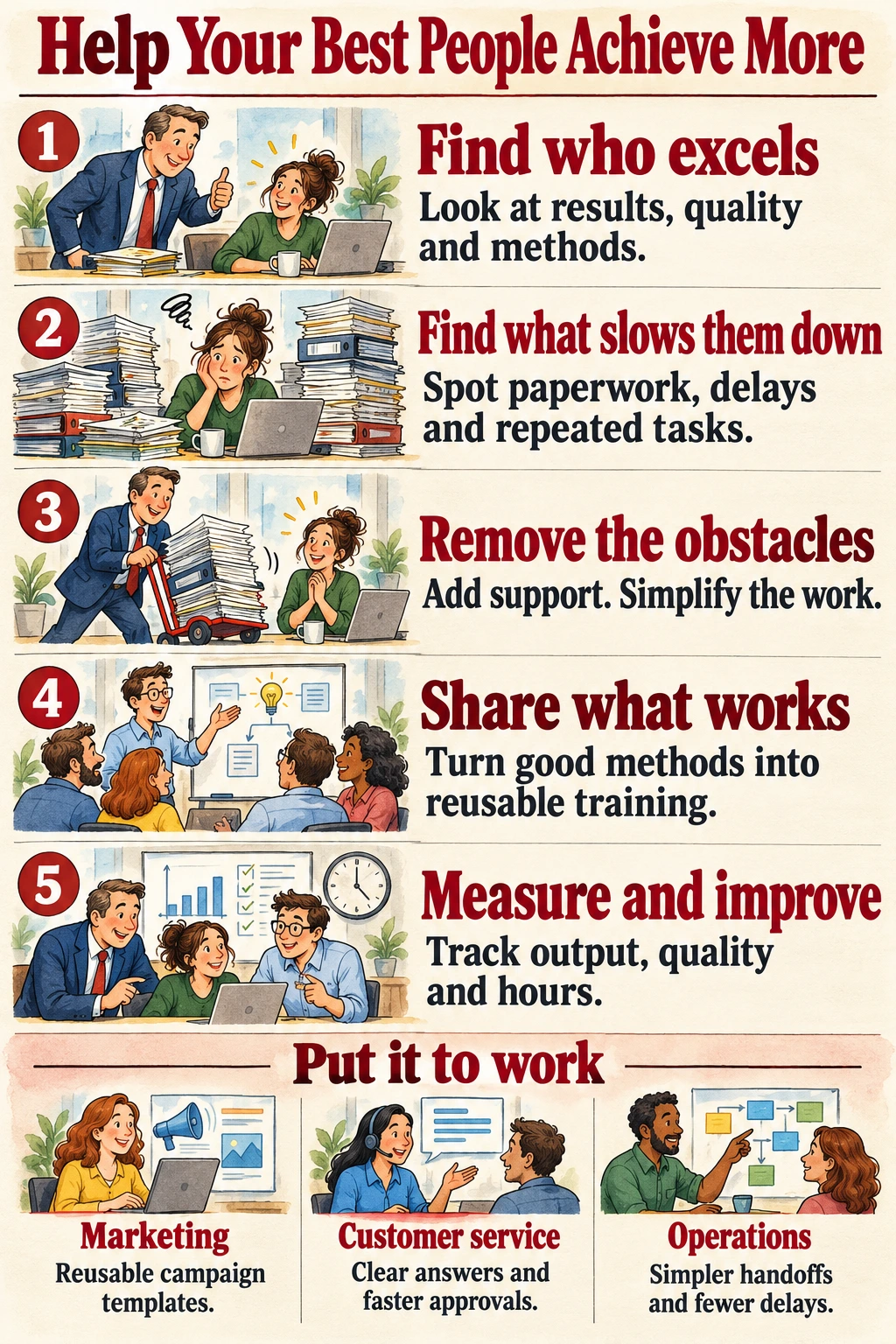
Read the infographic as text
- Find who excels. Look at results, quality and methods.
- Find what slows them down. Spot paperwork, delays and repeated tasks.
- Remove the obstacles. Add support. Simplify the work.
- Share what works. Turn good methods into reusable training.
- Measure and improve. Track output, quality and hours.
Marketing: reusable campaign templates.
Customer service: clear answers and faster approvals.
Operations: simpler handoffs and fewer delays.
The question to take back to work
What could your best people achieve if less of their ability were being wasted?
Find people whose abilities fit the work. Notice what they do exceptionally well. Remove the obstacles that consume those abilities. Give effective methods room to develop, make achievements visible, and let demonstrated results challenge the team’s assumptions about what is possible.
Some improvements come from the manager redesigning a role. Some come from the performer creating a better system. Some come from a new recruit whose approach changes everybody’s expectations. The shared principle is to keep investigating productive potential rather than treating present output as a natural limit.
Your best performers may have the most room to improve. First find out what is slowing them down.
Sources, attribution and evidence
The books provide intellectual context; the business stories are Tim’s recollections.
- Marcus Buckingham and Donald O. Clifton, Now, Discover Your Strengths (2001). Publisher’s excerpt, “The Strengths Revolution at Work.” Source of the quoted growth principle.
- Marcus Buckingham and Curt Coffman, First, Break All the Rules: What the World’s Greatest Managers Do Differently (1999). Publisher’s description of the later edition. Supports the discussion of talent selection, outcomes and role fit.
- Gallup, “Warren Buffett and You”, January 29, 2001. Identified by Gallup as an excerpt from Now, Discover Your Strengths.
- Marcus Buckingham, author’s account of studying Disney hotel housekeepers. Used for the specific illustrative details; this is a later retelling, not a quotation attributed to a particular book page.
- Marcus Buckingham and Curt Coffman, First, Break All the Rules, “The Third Key: Focus on Strengths,” discussion of Jean P. under “Spend the Most Time with Your Best People.” Book text in an online reproduction (viewer pages 197–198; pagination varies by edition). Source for the data-entry case and its sequence of milestones.
- Tesla, 2023 Investor Day presentation, manufacturing process and next-generation vehicle design. Illustrates rethinking the production method; projected efficiencies are goals, not evidence that every proposed saving was achieved.
The examples support thinking about strengths and productive methods; they do not establish a universal law that top performers always improve most.
Alice, Jill and Bill are substitute names. Their accounts, the sales-team practices, workshop example and performance estimates were supplied by Tim Barrie. The article was developed with AI assistance from his explanations and checked against the linked sources. Illustrations are conceptual, not photographs of the people or historical events.