
MI–0031 Recorded October 29, 2026 · By Tim Barrie
What If Democracy Elected Outcomes Instead of Politicians?
Let the public choose what we want to achieve. Select people for their ability to deliver. Independently assess what actually happens.
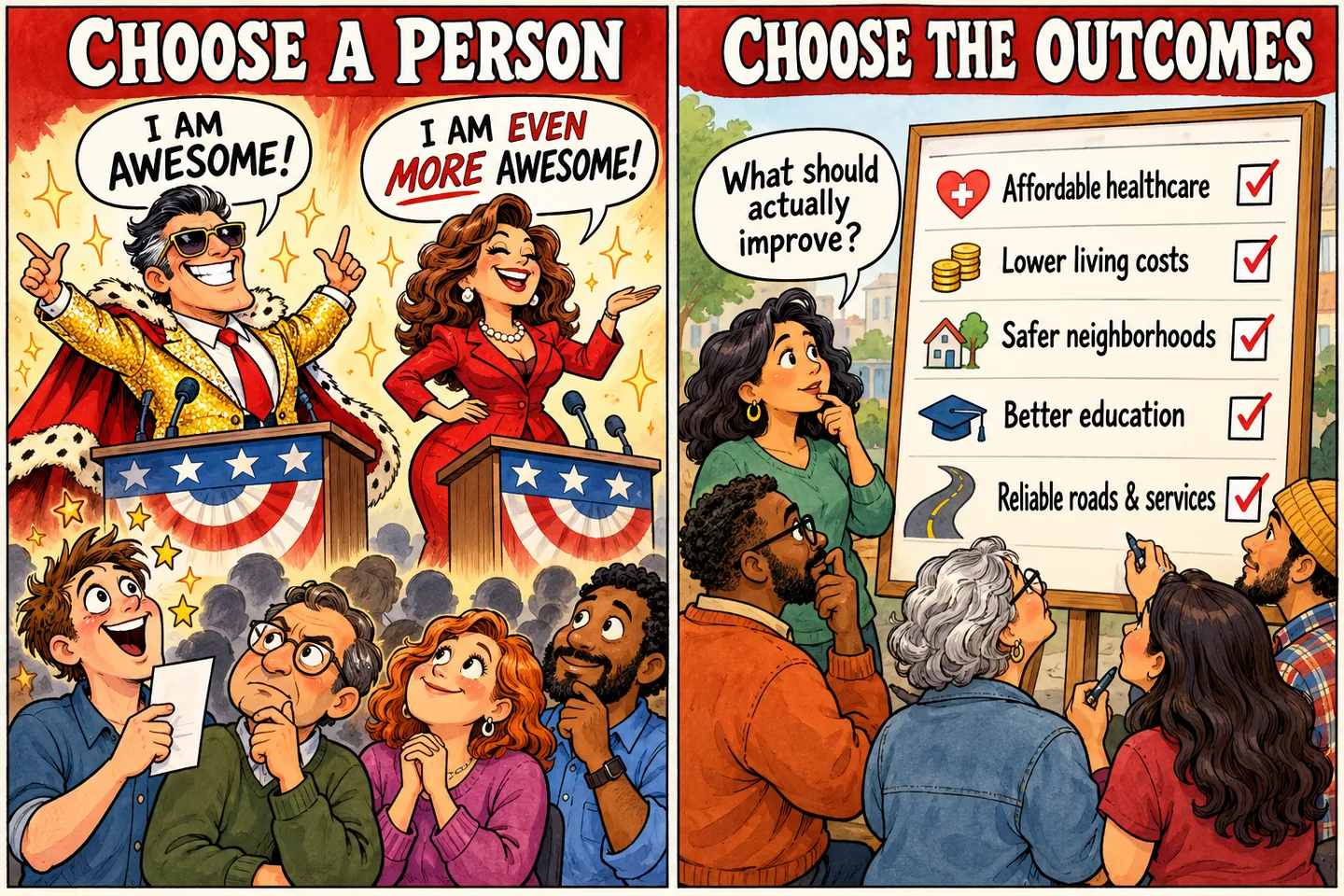
What if the biggest problem with current U.S. democracy isn’t that people vote for the wrong candidates, but that we’re asking them to vote for people rather than outcomes?

It started with a knock at the door
The encounter made me question the job we were asking the voter to do.
A woman came to my door with her husband, asking for my vote for a position as a judge. She was attractive, with prominent lips, bright red lipstick and a low-cut top that emphasized her breasts. I found myself wondering: was this a judicial election or a beauty pageant?
There is nothing inherently wrong with a woman looking attractive or dressing that way. The issue was the setting. I was being asked to make a serious decision about judicial office, and the encounter was giving me an immediate personal impression without giving me enough information to assess her ability to do the job.
“Distraction” does not quite describe what happened. It was not simply that I could not pay attention to her words. I felt drawn to her. That favorable feeling could have influenced my judgment even if I had heard every word perfectly.
Then, in my case, it backfired. I felt she was using her femininity to influence a decision that should depend on professional suitability. I became irritated. I felt manipulated, and my reaction was that I would not vote for her on principle.
That is my account of my reaction, not proof of her intention. She may not have meant what I inferred. Her appearance establishes neither competence nor incompetence. I suspect other men might have reacted more favorably, but this encounter cannot tell us how most men would respond.
Attraction, a sense of being influenced, irritation, rejection. The influence reversed direction. It still told me very little about whether she would be a good judge.
That last point is uncomfortable—and important. Even my resistance to the perceived manipulation did not amount to an informed assessment of her judicial ability.
Would you ask your neighbors whom to promote?
Being convincing about how good you are at a job is a different skill from being good at the job.
Suppose I wanted to promote someone in my business. Instead of assessing their work, I sent everyone in my neighborhood a video of each candidate describing their qualifications, experience and achievements. Then I asked the neighbors to choose.
Every candidate could explain why they were outstanding. Some would be more articulate, charming or convincing than others. But the neighbors would have no direct experience of their work and no independently verified assessment against which to check those claims. If they wanted to know more, they would have to ask the candidates—who would provide another persuasive account of themselves.
As their manager, I had observed their actual performance: who delivered, who needed help, who solved problems, and whose confident promises rarely survived contact with the work. My judgment was not infallible, but it rested on evidence the neighbors did not have.
Even the job needs explaining
These might be website developers or SEO specialists. Many of my neighbors might have little understanding of what those jobs involve. SEO means search engine optimization—but knowing what the initials stand for would not equip someone to assess an SEO specialist.
I could give them a short explanation. I could not give them years of professional experience in a briefing. A candidate could describe an ordinary accomplishment in dazzling language. Another could explain a genuinely difficult achievement rather poorly. Without understanding the work, how would the neighbors tell the difference?
There are two gaps: knowing what the candidates actually did, and understanding the work well enough to judge it. A persuasive video does not close either gap. Asking the neighbors to choose would turn a promotion decision into a presentation contest. They might pick the best employee. They might simply pick the person who made the strongest impression.

Please don’t let me select your baseball team
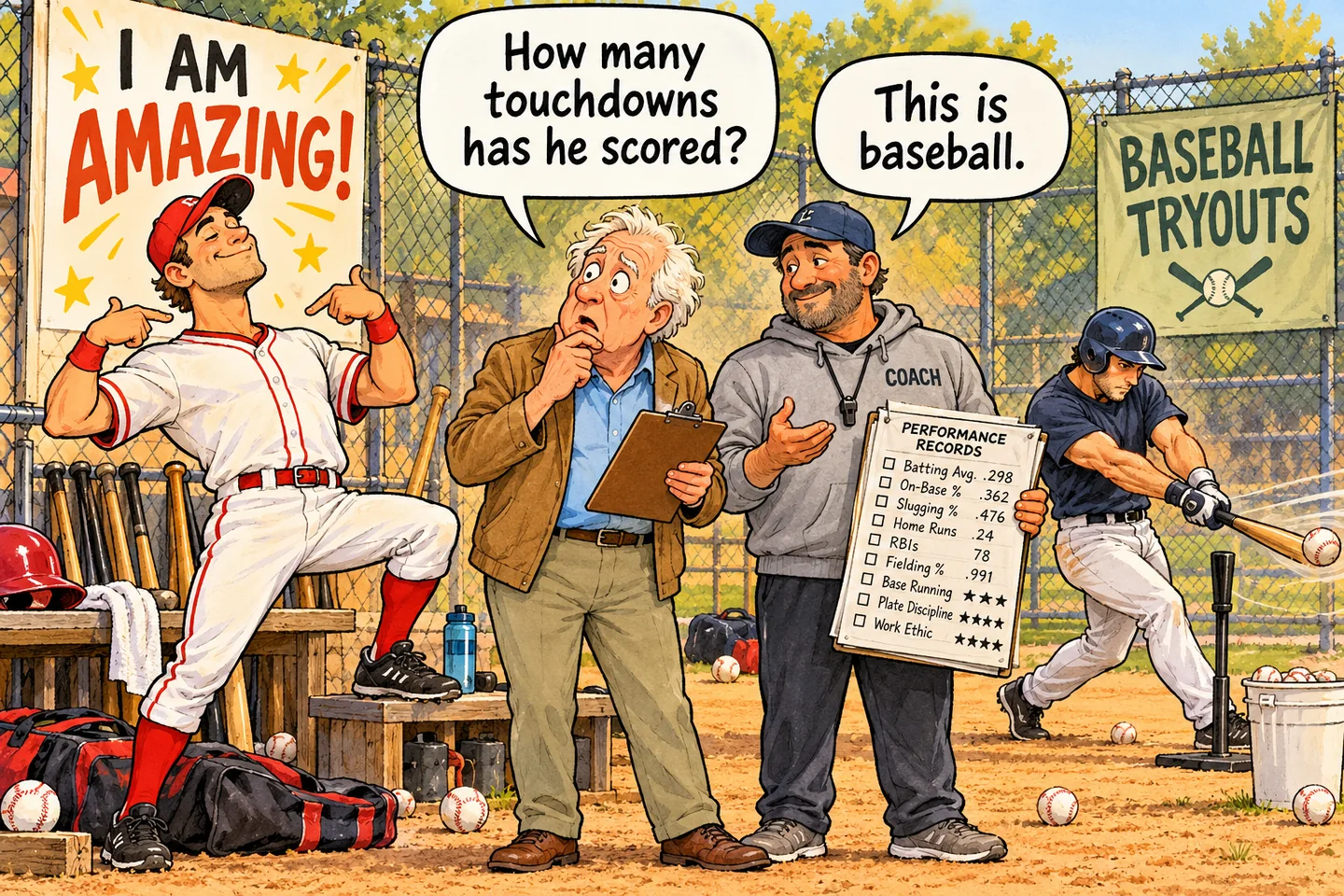
I want a winning team. That does not mean I know how to choose its players.
When I tried to explain this using sports, I started talking about baseball players, touchdowns and basketball statistics. I had mixed up the sports before I had even reached the selection decision.
That confusion is the point. I do not know enough about these sports to name the relevant measures reliably, let alone interpret them. Give me a video of each player explaining how brilliant they are, and I could tell you whose presentation I liked. That would tell you very little about which player deserved promotion.
Someone who understands the sport could examine verified performance records, consistency, the quality of the opposition and suitability for the role. The figures would not remove every judgment about teamwork or potential. They would give a knowledgeable assessor evidence to examine instead of asking me to choose the most convincing account.
My ability to choose the most convincing player would tell you very little about my ability to choose the best player.
Now make the decision bigger
I can want lower inflation or better healthcare without possessing the expertise to assess a candidate’s technical understanding, proposed methods or claimed contribution to past results. Just as with sport, I may not even know which questions would expose a weak answer.
Citizens have firsthand knowledge of the difficulties they face and a legitimate voice in deciding what should improve. That does not automatically equip each of us to assess every specialist entrusted with delivering the improvement.
We are asking people to judge specialist competence they do not understand, using claims presented by the very people seeking their approval.
The employee example exposes the gap between claimed and observed performance. My sports confusion exposes the expertise needed to interpret that performance. The pilot example below makes the consequences of the selection method immediate and personal.
At my doorstep, I faced both gaps: I lacked an independently assessed record of the candidate’s work and the professional knowledge to evaluate her judicial judgment. A pleasant encounter could not supply either.
Presentation can influence us through charm, confidence, attractiveness or an impressive performance in front of a camera. Communication skills can matter to leadership, but they cannot substitute for evidence of the ability to do the work.
Research offers a related caution. Todorov and colleagues found that judgments of competence based on candidates’ faces predicted congressional election results better than chance. That is an association, not proof that appearance caused the outcomes; it does not establish that sexual attractiveness wins judicial elections. Research reference.
Keep democracy. Change the decision.
The public chooses the destination; competence determines who can help us reach it.
The question is not whether people deserve a voice in how they are governed. They do. The question is whether selecting personalities is the best way to exercise that voice.
My proposal separates four responsibilities that we often bundle together:
- Citizens choose outcomes and priorities. What should improve, by how much, over what period, with what resources and acceptable trade-offs?
- Qualified selectors appoint people capable of delivering. Relevant knowledge, demonstrated work, judgment and integrity matter more than campaign polish.
- Independent evaluators examine results. Did life actually improve? What did it cost? Who benefited, who was harmed, and how much of the change can reasonably be attributed to the work?
- Citizens judge whether delivery was good enough. Informed by independent evidence and their experience, they vote on whether the agreed outcomes were achieved without unacceptable harm—not on the personality appointed to do the work.
Citizens could revisit priorities on a four-year cycle. This is a proposed review interval, not a claim that all existing U.S. offices have four-year terms. Longer-term work would also need protection from arbitrary abandonment whenever priorities change.
Would you elect your pilot?
Imagine passengers assembling at the departure gate to elect their pilot. Both candidates promise to get them to Hawaii. Each gives a confident speech, presents glowing accounts of past achievements and hands out a very convincing brochure.
A passenger asks the gate attendant, “Who checked their flying records?”
“We leave that to the passengers. Each candidate has a very convincing brochure.”
The problem is not that nobody offered a destination. It is how we establish who can actually get us there. Passengers should not have to reconstruct flying competence from speeches, endorsements and competing accounts of past landings. That requires agreed standards, verified records and assessment by people qualified to understand the evidence.
Having access to claims about performance is different from having a dependable assessment of performance. If candidates choose the evidence, define success and assign themselves credit, the public is judging competing presentations. The ability to win support and the ability to do the job are different capabilities.
The candidate should not get to define the test, mark their own paper, and then persuade the public that they passed.
The proposed standard is independently verifiable evidence: relevant training and experience, demonstrated results, comparable criteria and professional scrutiny. Assessment still requires judgment, especially when other people and circumstances contributed to a result. Those uncertainties should be made explicit rather than buried beneath a confident speech.
Citizens should decide what outcomes they want and which trade-offs they accept. The competence of those entrusted to deliver them should be independently assessed—not inferred from their ability to win applause.

“Better healthcare” is a wish. Define the outcome.
The hard work of deciding what success means belongs at the center.
“Better healthcare for less money” sounds attractive because it conceals the difficult choices. Does better mean shorter waits, wider access, better recovery, fewer preventable illnesses, lower household costs—or some agreed combination?
Before a vote, people would need understandable options with realistic costs and consequences. A proposal to shorten waits should explain what happens to staffing, quality and eligibility. Reducing spending by excluding people from care would not count as achieving an outcome that promised better access.
Experts could help develop and assess the options. Citizens would also need a route to propose priorities that experts had not included. Otherwise the people who prepare the menu quietly decide what the public is allowed to want.
Science can help test whether something works. It cannot decide on its own how society should weigh freedom, fairness, prosperity or environmental protection. Those choices remain democratic.
The difficulty of defining outcomes is not a reason to abandon the idea. It may be its greatest strength. We would be directing more public effort toward deciding what worthwhile success actually looks like.
Fix the road. Don’t shorten the ruler.
A better number is useful only when it represents a better result.
Suppose an administrator is rewarded for reducing reported crime. Discouraging reports might improve the number while making the public less safe. Suppose another is rewarded for faster appointments. Removing difficult patients from the waiting list might create a splendid dashboard and a worse service.
Independent assessment must look behind the headline measure: consistent definitions, accessible underlying evidence, checks on excluded cases, multiple indicators and the experience of people using the service. Evaluators should report manipulation explicitly, as well as uncertainty and external events beyond an administrator’s control.
This connects directly to Why Government Keeps Solving One Problem—and Creating Another. A system needs the capacity to discover consequences and correct its course, not just congratulate itself for meeting its original target.

Who watches the people doing the watching?
Professional selection needs accountability of its own.
Replacing an election with an appointment does not automatically produce meritocracy. A selection body could favor friends, protect insiders or define “qualified” to mean “people who agree with us.” An evaluator could become dependent on the people being evaluated.
Agree the scoreboard before the job begins
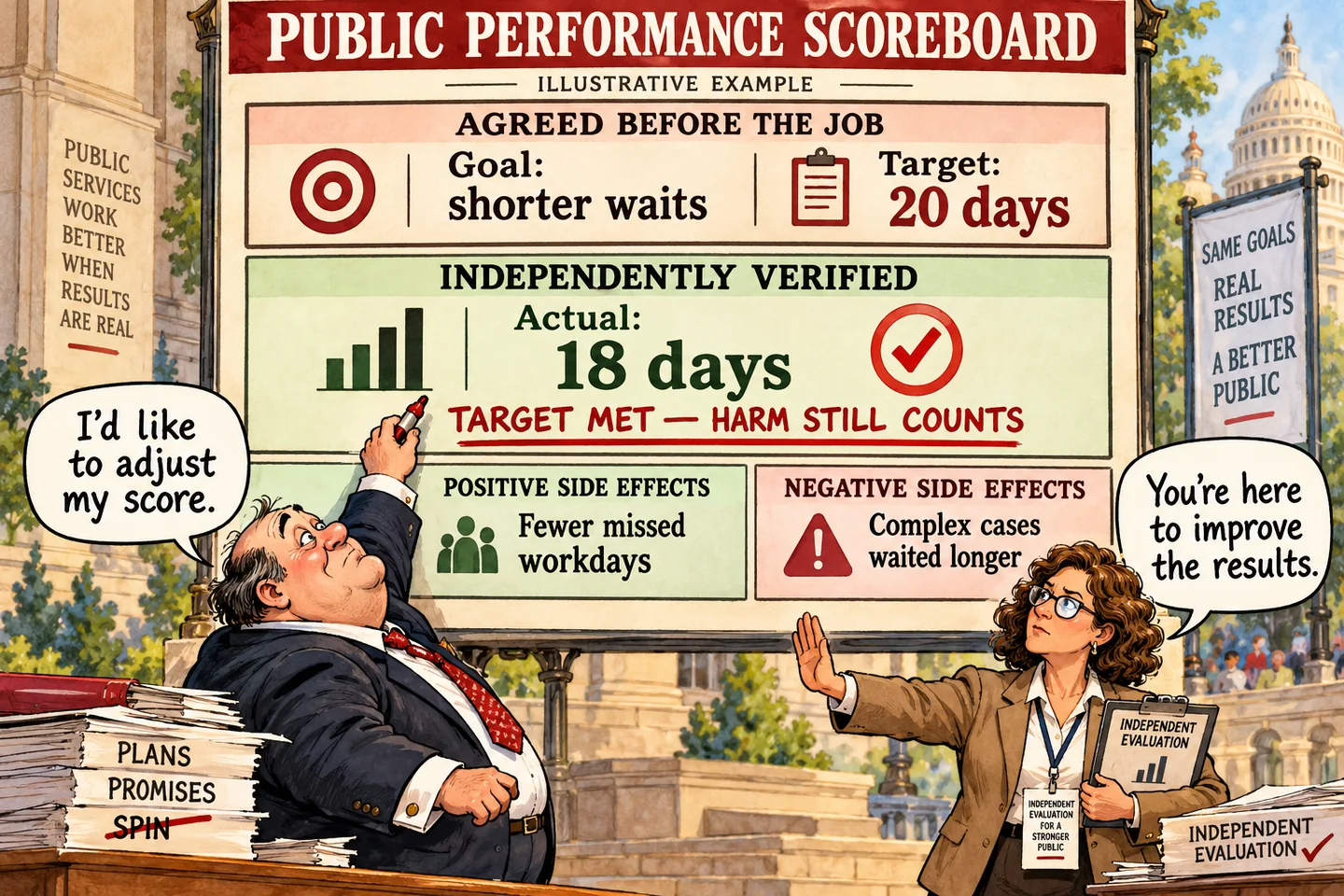
The outcomes and scoring rules are agreed beforehand; independent evaluators measure the results afterward. Each person responsible for delivery should be assessed against a published set of outcomes, with a baseline, target, time period, budget and safeguards. The measurement methods should be specified before performance is judged, rather than rewritten afterward to fit whatever happened.
The public scoreboard should show the agreed outcome, the target and the independently verified result. Beside each result, it should list positive and negative unintended consequences: additional benefits, hidden costs, people helped and people harmed. These effects belong alongside the headline score, not buried in a footnote.
For example, imagine a target of reducing a defined service’s typical waiting time to 20 days. An independently verified result of 18 days meets that target. Fewer missed workdays might be an additional benefit. But if complex cases waited longer or difficult patients were excluded, that harm must appear beside the apparent improvement. A target met at an unacceptable cost should not appear as an unqualified success. These numbers are illustrative, not a proposed clinical standard.
The people delivering the work can supply records and explain their decisions, but they do not award their own marks. Evaluators must be able to check underlying evidence, disclose their methods and conflicts, and publish findings without the subject’s permission. Their assessment should distinguish the individual’s contribution from outside circumstances, identify uncertainty, and remain open to independent challenge.
The scoreboard makes accountability visible, but it does not make the evaluators immune to bias or capture. Their independence also needs protection.
The design therefore needs published selection criteria, disclosed conflicts, reasons for appointments, independent review, staggered appointments and workable procedures for investigating and removing misconduct. Citizens must retain a meaningful route to challenge the institutions themselves. The exact appointment and removal architecture remains a major design question.
Basic rights also need protection against majority preferences. An outcome does not become acceptable merely because it is popular. And implementation choices can contain value judgments: when a proposed method materially changes the agreed trade-offs, the decision should return to a publicly accountable process.
For judges, “outcomes” must mean a fair, accessible and independent justice system—not pressure to convict more people, favor popular parties or deliver politically desired verdicts. Judicial independence and due process are boundaries within which the model would have to operate.
A proposal worth testing, not a finished constitution
The useful comparison is between real alternatives with real failure modes.
This is not a claim that every element is new, or that existing democracy consists only of personality contests. People already vote on issues as well as candidates, and public institutions already use professional appointments and performance review. Participatory budgeting and deliberative processes provide related examples of citizens helping shape public decisions. OECD background.
Citizens choose the outcomes—and judge whether they were delivered
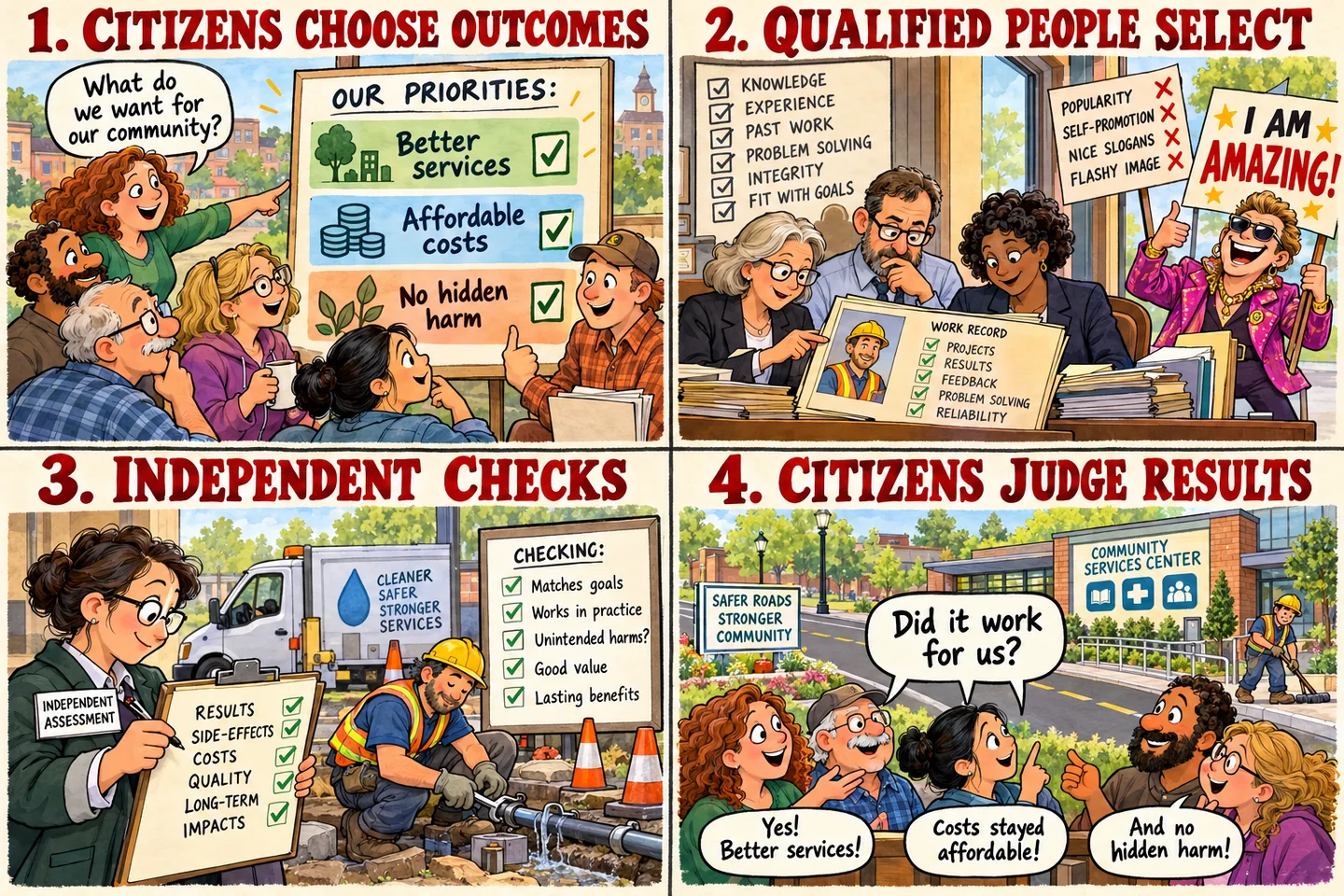
The proposal is to make outcomes—not candidates—the subject of democratic choice. Citizens vote on what they want accomplished, then vote on whether it was delivered without unacceptable harm. Choosing the people responsible for delivery is a separate professional task: merit-based selection by people qualified to assess that merit.
The public should not have to choose a personality to obtain a result. A capable person who quietly delivers should not lose out to someone better at announcing their own brilliance. What matters is whether the work gets done, within the agreed costs, safeguards and trade-offs. Integrity, conduct and accountability still matter; personal appeal should not determine who is entrusted with delivery.
The independent scoreboard and the public’s judgment serve different purposes. Independent assessment establishes the evidence, including unintended consequences and uncertainty. Citizens then judge whether the improvement reached their lives and whether the consequences were acceptable. A technically successful score should not override people’s experience of a service that still fails them.
Citizens choose what success should look like. Qualified selectors appoint people capable of achieving it. Independent assessment establishes what happened. Citizens judge whether it was good enough.
A modest pilot could begin with a clearly bounded public-service priority. Publish the budget, constraints and outcome measures; establish qualified selection and independent assessment; then compare actual service quality, cost, public influence and unintended effects with the previous approach. A pilot would test parts of the proposal, not prove that an entire constitution should be replaced.
No arrangement eliminates conflict, ambition or error. The question is whether it places those forces inside a process more likely to produce worthwhile results.
The connection to an AI that missed Ctrl+C
An impressive performance can distract us from the job the system should accomplish.
In I Needed a Ditch. You Brought an Atomic Bomb., an AI became absorbed in complicated ways to preserve a conversation. The practical solution was to select the text, copy it and paste it. Sophistication had displaced attention to the actual need.
The scale is different, but the question is the same: are we organizing the process around the result people want, or becoming absorbed in the process itself?
The AI insight concerns practical problem-solving. This one concerns democratic choice, competent appointment and public accountability. Their shared lesson is to start with the desired outcome and judge the mechanism by what it delivers.
What if the biggest problem with current U.S. democracy isn’t that people vote for the wrong candidates, but that we’re asking them to vote for people rather than outcomes?
Sources and perspective
A personal encounter led to a proposal, not a proven political remedy.
The doorstep account and business analogy are Tim Barrie’s recollections. The candidate is unnamed. Her intentions and professional ability have not been established here. The cartoons are fictional, exaggerated illustrations, not depictions or evidence of the actual people.
- Alexander Todorov and colleagues, Inferences of competence from faces predict election outcomes, Science, 2005. A related finding about appearance-based competence judgments, not a study of this encounter or proof of its proposed mechanism.
- OECD, Guidelines for Citizen Participation Processes, 2022. Background on participatory budgeting, deliberation and public involvement; not validation of this complete proposal.
Developed from Tim’s discussion with AI assistance. The framing is his contribution to an established conversation about democratic participation, competence and accountability. No claim of historical priority is made.