
MI–0001 Recorded August 28, 2026
Emotional distance improves problem-solving
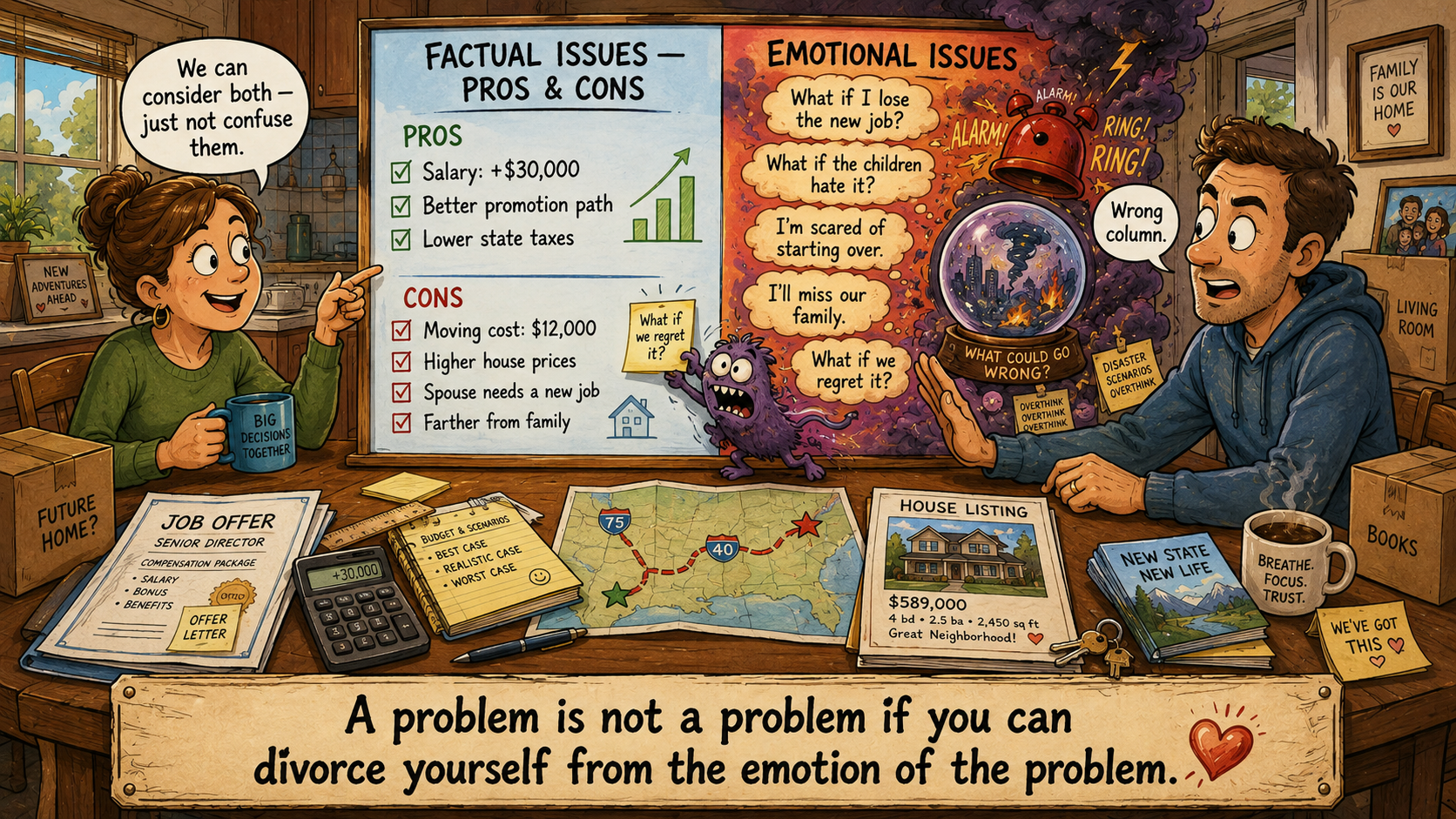
A problem is not a problem if you can divorce yourself from the emotion of the problem.

Refined insight
A problem becomes easier to solve when you can separate it from the emotion surrounding it.
The underlying insight
Someone outside a problem can often see a solution more easily because that person is not emotionally entangled in it. The goal is not to deny emotion, but to prevent emotion from unnecessarily restricting the available solutions.
Emotional distance is not merely a state of mind. It can be created deliberately. The following tools help separate the facts, choices, assumptions and feelings that can become tangled together when a problem remains inside your head.
Tools for creating emotional distance
Write down every possible response
List every course of action you can think of, not merely the options you like or expect to choose. Include uncomfortable, inconvenient and imperfect possibilities, as well as waiting or doing nothing.
For each option, write down the pros and cons. Then separate what is genuinely doable, what might become doable, what is not realistic, what represents objective facts or probable consequences, and what represents fear, attachment, preference or an imagined outcome.
Writing forces vague worries to become visible and examinable. Some concerns that felt enormous turn out not to be problems at all. They were simply skulking about like a spider in the back of your brain.
Work separately, then compare
When solving a problem with a spouse, partner or colleague, each person should make a separate list first. This helps prevent one person's framing from shaping the other person's thinking before both perspectives have been expressed.
Compare the completed lists and create a master list. One person's pro may be the other person's con. One may see a problem or possibility that never occurred to the other. Those differences reveal hidden assumptions and misalignments that can now be discussed directly.
Argue against your preferred answer
Once an answer begins to feel right, deliberately make the strongest credible case against it. This is steelmanning: presenting the opposing case as strongly and fairly as possible. It forces you to see the issue from another point of view and think through the best counterargument, not merely the easiest objection to dismiss.
Challenge every apparent advantage. Ask what could weaken or invalidate it. Challenge every disadvantage attached to the alternatives. Is it certain, exaggerated, temporary, avoidable or based on an assumption?
The purpose is not to reject a good answer. It is to discover whether that answer remains good after receiving the strongest challenge you can give it.

Remove the sunk cost and the history of the loss
Imagine that you suddenly appeared in your present circumstances with no history of how you arrived there. You inherit exactly what exists today: the resources, obligations, opportunities, relationships and limitations, but not the memory of what used to exist or what was lost.
Would a person who magically landed in your situation see a disaster, or a workable starting point filled with possibilities?
This goes beyond the conventional sunk-cost question. It also removes the emotional reference point created by continually comparing the present with what existed before. The loss remains real, but it no longer defines the value of everything that remains.
Tim used this after the 2008 financial crisis, when he and Sonja lost the majority of their savings. Although they still had resources and some savings, the magnitude of the loss weighed heavily on him. When he imagined arriving in their current circumstances without knowing the history, he saw that the situation itself was not so bad. It contained choices and many things they could still do.
That shift did not recover the missing money or pretend the crisis had not happened. It created enough emotional distance for Tim to function, act constructively and help create the recovery that followed over time.
Borrow somebody else's emotional distance
Take the problem and your completed list to a thoughtful, trustworthy person who is not involved and has no hidden interest in the outcome. Explain the situation and ask, “What have we missed?”
A neutral outsider may notice an omitted option, unsupported assumption, contradiction or consequence that those inside the problem cannot see. Their opinion is an input, not a verdict; they may lack context. The value is in exposing blind spots rather than validating the conclusion you already prefer.

Change your state to change your perspective
Sometimes a problem remains stuck because you keep encountering it in the same setting, routine and emotional state. Interrupt the loop: go somewhere different, stay with a relative, take a long weekend away, walk in a forest, ride a bicycle, take a long walk or simply break the routine.
For some adults, a few drinks may reduce tension and produce a different subjective perspective, but that should not be confused with better judgment. Alcohol can impair reasoning and increase impulsivity. Never combine it with driving, and reconsider any apparent insight sober before acting on it.
The useful principle is the state change, not alcohol. Travel, exercise, nature, rest, novelty and temporary distance can provide it more reliably. Then return to the written list and see whether the same facts look different.
None of these techniques makes emotion irrelevant or guarantees a correct answer. They create enough separation for the problem to be considered rather than merely felt.
A sister insight: turn the problem into a puzzle
Sometimes emotional distance can begin with a single word. MI–0012, “A puzzle is a problem with the emotion removed,” shows how calling the same situation a puzzle can replace the feeling of being burdened by it with curiosity about the first piece to solve.
Origin and context
A life learning developed by Tim and Sonja many years ago. They learned not only to ask how they were emotionally locked into one way of thinking about a problem, but to use practical methods for creating the distance needed to see it differently.
Original formulation — provisional
Where this insight comes from
Tim and Sonja developed and used this wording as a shared life learning. We found no close earlier wording, although the idea independently parallels psychological research on self-distancing: stepping back from an emotional experience to reflect on it more constructively.